Showing posts with label Journal Entries. Show all posts

Sunday, 23 February 2014

January Blog Post

6th January - 31st January

6.01.14 - Release Based Contemporary
This was our first lesson back after Christmas and I was a lot more engage than I thought I would be. I began with continuous movement to get started and this really worked for me. Continuous movement doesn't always have to be fast and busy, I prefer a slower and more flowing approach in order to keep moving. I found it easiest to connect with some of the principles we have studied in Experiential Anatomy in particular, naval radiation, yield/ push and reach/ pull.


13.01.14 - Release Based Contemporary
In this lesson, I was working with the connection between the heels, tail and skull. This is a focus I have engaged with the most since the end of Year 2. I don't why, but I can always come back to this notion when I am stuck for movement. I like the feeling of being connected down the back surface of my body, I can really feel a stretch through the back of my legs. I don't necessarily think of my spine in order to find these connections, I think its more of a cellular/ skin feeling. I documented my findings through this movement in the form a family tree. This is the first time I have journalled like this and I would like to use it again because it shows my initial thoughts at the bottom and how these expanded and grew throughout my moving experience.


17.01.14 - Experiential Anatomy
At the start of the lesson we wrote our aspirations for Term 2.
My aspirations are:
- To always arrive in the space early to give time to prepare for class
- To continue to explore new/ unfamiliar ideas to step out of my comfort zone
- To keep up to date with readings, journalling and blogging.
Reviewing these aspirations now, I feel that I have been arriving with enough time to do what I need to before the lesson starts. Sometimes I enjoy just resting in the space and sometimes I feel more active. I do try to explore unfamiliar ideas however, I like to stay with what I know works for me too. In Experiential Anatomy, we have been learning about different movement patters so I have been able to experiment with new ways of moving, for example, homologus, homolateral and contralateral. I haven't really kept up with my readings and blogging because I have focus a lot of time to my dissertation. However now it is completed, I will dedicate more time to this work.
In the main body of the class, we studied the homologus movement pattern, also known as the frog pattern. It marks the distinction between the upper and lower body. The movement to me, is symmetrical with both legs together and then both arms together. The movement mainly uses the sagital/ wheel plane of movement. I enjoyed learning about this, because it is something I have not studied before and I find it interesting.


22.01.14 - Workshop with Cecilia Macfarlane
In this workshop, we learnt about the differences between therapy and therapeutic. From our discussion, I now understand that therapy is a form treatment in which a professional gives therapy to someone on a one to one basis. The term therapeutic is something that relaxes us for example, it could be shopping or watching television, it is something that can be done individually without the help of a professional. In the following Experiential Anatomy lesson (24.01.14), we discussed what we had learnt and taken away from Cecilia's workshop and what questions had been provoked.
- Speaking and listening is a form of therapy
- Energy does not always come from the obvious places
- Dance movement psychotherapy is a form of therapy. It is undertaken in a clinical setting, there is a client and therapist role and it is on a one to one basis.
- Dance artists offer therapeutic creative services. It is undertaken in a group setting and in a dance setting rather than a clinical setting.


24.01.14 - Experiential Anatomy
We started this lesson by creating a homologus movement phrase that we shared with a partner and then with another partnership. We were focusing on where the intention of the movement was initiated from. This was a real turning point and discovery for me personally. I realised that, "you don't have to dance identically to have the same intention in moving."
After this, we studied the homelateral movement pattern, also known as the lizard pattern. This is where the right arm and right leg move together, and the left arm and left leg move together.


31.01.14 - Experiential Anatomy
At the start of the lesson we began working with a partner. I noted the differences between mine and Chelsea's movement. Chelsea worked with the homelateral pattern, balance, folding and vertical plane. On the other hand, I worked with the homologus pattern, sweeping movements and was more grounded to the floor.  
We continued the progression with movement patterns and focused on the contralateral movement pattern. It focuses on the relationship between opposites in the body and is present in mammals. It differentiates between the 4 quadrants of the body. This movement pattern allows us the crawl, walk and run.


Sunday, 5 January 2014

Study Group Tutorial (December)

I found the study group tutorial really helpful because I was able to ask questions about areas I was still unsure of. I think it is also helpful for tutors to see the progress we make outside of lessons as well as in.

My Questions
  • Could you explain the difference between Yield and Push/ Reach and Pull in more detail?
I already understood:
Yield and Push - Establishing your own personal kinesphere.
Reach and Pull - Breaking through the kinesphere.
However I still did not understand this fully.
Natalie explained:
Yield and Push - Inner focus.
Reach and Pull - Hearing/ seeing out into the world.

  • With hands on cellular touch the pressure is dependent on the partners preference. Is there a point where it becomes too much and therefore, becomes another form of touch?
Natalie explained:
The answer is yes, if cellular touch becomes too firm, it can become muscular touch or boney touch.


My Findings
Being given these questions to answer for the group tutorial helped me to discover new things that I had not understood/ realised previously.
  • When doing some additional reading, I discovered a technique called Eutony. In the reading, it explained that this technique a distinction is made between touch and contact. This lead me to question if there is a distinction between the two in BMC?

  • Homologous, Homolateral, Contelateral Movement. It wasn't until Release Based Contemporary, when I found it difficult to initiate crawling with my legs that I really undertood this concept I had read about! It was a real light bulb moment for me and I was able to understand why I fould this difficult and what sort of mover I am.

Wednesday, 27 November 2013

November Blog Post

24th October- 22nd November
 
Another month has passed far too quickly and there are plenty of things to blog about. So...
 
29th October - Release Based Contemporary
 
My Focus for this lesson was quiet ribs. I always thought that they were generally quiet in class anyway and haven't noticed any changes in other styles of dance either. However, the week before, when jumping, I noticed tension in my shoulders and my chest which changed the way I held my upper body. This week, I wanted to pay particular attention to this area in order to improve it.
 
Landing Exercise One: In this exercise, when leaning backwards over the legs, I have a tendency to arch my back and drop my head backwards. However, after talking about the head to tail connection a lot recently I realised that I needed to keep the connection in this movement also. Since, I keep my tail bone, spine and head in a straight line.


1st November - Experiential Anatomy
 
In this lesson, we focused on the Naval Radiation Pattern (Star Fish Pattern). We were given a task in which we had to lie in the star fish position and visualise a colour dispersing from the centre of the body and out to the limbs. This was a very clear and vivid image for me, and instantly made me think about this video below...


4th November - Improvisation and Instant Composition

Today, both Katye's group and Polly's group worked together. In this lesson, we began working with levels in moving, for example:
Level 1 - Floor
Level 2 - Sitting
Level 3 - Pelvis lifted off floor
Level 4 - Standing

We then worked with the notion of curling and uncurling the spine. I moved in a way that my body arched forwards over the legs and then backwards into a high release. I imagined this, as a flower with two leaves arching in different directions. In my journal I tried to reflect this in my drawing.


5th November - Release Based Contemporary

Today, we were asked to reflect on the aspirations we set ourselves at the beginning of the year. I feel that I working consistently in class to maintain my concentration levels. I sometimes feel now that I can't always fully engage, but I still continue the movement to try to recapture this again.

I feel that I want to make the most of my final year of training because classes will be less accessible to me as a dancer when I graduate.


8th November - Experiential Anatomy

In this lesson, we discussed the Mouthing Pattern and how the mouth and digestive system offers a line of support through the body. After moving with an awareness of the digestive system, this is the drawing I created.


For me, I see the digestive system as one long line travelling from the mouth, through to the stomach and to the intestine. At the intestine, this line becomes a tangle and a maze inside the body. This is what the picture portrays.


18th November - Skinner Releasing Technique

I received a lot of useful feedback during this session when moving alone and in contact with a partner. This feedback was:

Keep moving forwards, not backwards
Keep eyes closed
Keep chest open, not closed (front surface)
Keep pelvis in contact with partner.

I think that this feedback reflects things I have previously tried to improve but in the moment of dancing, this time, they have slipped my mind. In second year, I began to work with the idea of moving forwards because I received that as feedback then as well. I have always struggled to keep my eyes closed in certain tasks and clearly this is reflected in the feedback I received again today. I have not previously noticed my chest being closed before but when it was pointed out to me today, I could see why this correction had been pointed out to me. In future, I am going to try to be aware of this feedback when working in partners again. I feel like the last snip it of feedback sometimes applies to me but sometimes doesn't. When working in partners, it is important to apply a lot of pressure and receive that pressure back in order for Contact Improv to work. Sometimes, if I do not receive enough weight off my partner, I am reluctant to give them my weight and risk falling over! Depending on how I work with a particular partner depends on how I respond to this sort of task and today, I couldn't give my weight as it did not feel safe to.

In this lesson, we also worked with the arms as sails, from the shoulder to the little finger and down the length of the body. The spine was a rope hanging down the centre. With this imagery, I felt expansive, wide, seeing out, fluid, swirls of energy,
continuous movement...


I was given feedback in which it was explained to me that I needed to be able to fold more easily in the hip, knee and ankle joints when moving. I understand this as usually, I tend to fold only at the hip joints.

Thursday, 24 October 2013

October Blog Post

Monday 30th September - Thursday 24th October

This term is going too fast already! We have covered so much in our Movement Studies practice so far and I am going to highlight some of the key areas that have been beneficial for myself.


4/10/13

In our first Experiential Anatomy lesson, we were asked to note our aspirations for our final year and also to reflect upon our previous year. This task really helped me to think about how I personally want to benefit from practical classes as well as targets to aim for.


Aspirations:

·         To continue or better the level of concentration I was working with last year.
 
·         To develop my intellectual knowledge to coincide with my physical practice.

·         To find more ideas that I particularly enjoy working with and exploring.


How can I do this?

·         Read more publications/ articles that are related to areas covered during physical practice.

·         To be prepared for classes so I can fully engage.


What am I bringing from Yr 2?

·         Connection between the skull, tail, and the feet.


In the same lesson, we were asked to define, ‘What is a Somatic Practice?’ Considering it is what I have been studying for the last two years, I would assume I could explain it. However, when actually asked, it was much harder than I thought! Over the coming weeks, I hoped had hoped to develop my understanding of this area.


4/10/13

We have not studied Feldenkrais before so this was going to be a next experience for us all. I did some basic research into this subject in order for me to understand why we were doing it.


What is Feldenkrais?

·         It is a somatic educational system designed by Moshe Feldenkrais.

·         It aims to reduce pain or limitations in movement to improve physical function.

·         It expands movement repertoire.

·         It works with kinaesthetic and proprioceptive self-awareness.


8/10/13

At the start of Release Based Contemporary, we were asked to think of something we would be working with for the duration of the class. I said that I would be thinking of the connection between the spine, shoulders, arms, hands and to the fingers. I had a very clear image in my head of the wing span of a bird and consequently, I drew this in my journal.


18/10/13

During this Experiential Anatomy class, we spoke about the systems of the body and how they are categories differently depending on who is looking at them. In particular, we focused on the anatomical and BMC categorisations.


We also had to move for a time and then draw which body system we were most aware of whilst moving. I could feel the blood pumping and racing around my body and therefore, I drew the circulatory system.


21/10/13

In SRT, I began with a connection with the bone and the joints, especially in my arms. Over time, this did start to drain through my body into my knees. We were then asked to think about the connection between the base of the skull and heels which married nicely with my already present thoughts about bone.


We moved on and worked in partners. I can’t quite explain how, but I could feel forces opposing… resistant… pushing… repelling… resilient. The energy and effort required was very intense. My partner compared it to magnets which I thought was a great image to explain the sensation.


21/10/13

 For Improvisation and Instant Composition, we were set a homework task in partners to investigate the hand. Having completed the task, here are the thoughts that I was left with.


Overall, I feel I am already meeting some of the aspirations that I set at the start of the term. Having being offered several reading about Somatic Practices, I feel I am now much more able to explain what they are. These readings have also helped with my dissertation research as I am looking into SRT, a Somatic Practice.


Friday, 12 April 2013

Again...

I always seem to be posting about SRT classes!

This week, we focused on the spheres and globes around the body. The are situated around the skull, ribs and hips as shown on the journal picture. We worked on a partner graphic to trace these spheres of the body. The lines were continual and intertwining between one another. I felt this represented how they all work together in unison.

Our attention was also brought to the solar plexus and how deep it sits within the body. I pictured mine and a black hole swirling around within my ribcage.

Imagery


Here is an excerpt taken from my journal from a SRT class. The pictures I have used are there to represent how I felt and what I experienced therefore sometimes I don't feel the need to fill my pages with words. Often, less is more.

Hip Sockets

The post that I am currently writing are taken from quite a while back and I just haven't had time to type them on to my blog. The majority of post will be taken from my journal and expanded on.

I always feel that SRT is very clear to me and I can vividly see the images we are creating from the partner graphics and the moving. In this particular lesson I was drawn to the imagery I created when thinking about the hip sockets opening when working alone. I pictured them to be like butterfly wings opening and closing. I could feel the valley spaces widening between my bones and joints.

This feeling was reinforced when we carried out a partner graphic on the legs. My legs felt like they were hanging from the torso. It felt like there was nothing between my legs and my torso, my hips felt weightless.

Tuesday, 20 November 2012

Spilt Milk

Wednesday 7th November


  • Showing different Social Dances.
  • Metronome.
  • Dancing with the hands- gestures.
  • Humour.
  • Using classical music for more modern dances.
  • Popular dance crazes.
  • Dance theatre.
I really enjoyed watching this piece because everybody could relate to it in some way. Everybody knew the popular dance crazes even if they did not know the social dances as well. The use of repetition made it easy to watch because it would always come back to a familiar point you had seen before.

I think having now entered my second year I am becoming increasingly aware of my FMP next year and having to think of ideas for my own work. I am seeing work in a whole new perspective and retaining ideas others have used in order to widen my vocabulary for my own project.

Mannequin Dance


This was my journalling after the first rehearsal with Mannequin Dance (Hannah and Julia's FMP company). We each bought in items that defined us and represented who we are.

As a group, we organised the objects into categories for example, colour, purpose etc.
We also spent time with one individual item just observing what we noticed.
I wrote about a photo frame.

Thursday, 8 November 2012

Day One- Intensive

Monday was our first day working with Marina on our performance project. I'm glad we have had the opportunity to work with Marina in our phrase class since the start of the year because it has enable us to get to know her a little and understand her style of dancing.
 
I did not know what to expect because obviously its the first day and we do not know what ideas the choreographer has. From the readings we were given, I assumed we may be working with sounds and the head. From the questions Marina asked us to answer, I thought she just wanted an insight into why we dance.
 
To begin with, we spent a lot of time talking about the questions we were asked and our individual responses. It brought back emotional connections to things that had happened in my dance career previously. Things that I probably didn't want to talk about and things I had forgotten for a while. However, listening to everyone elses answers, I feel my opinion has also changed. We then began to move:
 
 
Task 1
  • Warm up.
  • Openness.
  • Material about your joy of dancing.
  • Music changes.
  • Changing energy.
  • For the first time this year I felt I was moving how I wanted to move. I found my contemporary style again.


Task 2
  • Openness with a witness in the space.
  • 2 types of open- being open in your movement and being open as a person.
  • There is a difference between reaching and opening.
  • Open, widen, expand, creating space, opening the heart.
  • I was open in my movement whereas Kate wasn't, she was more reserved.
  • You need to close before you can open.
  • Moving into new spaces.


For myself
  • Embrace whats new, what I've come to study.
  • Tone and quality in voice, "I wasn't supposed to be here." Express that in movement.
  • Difficult being here. Showing both positive and negative.
  • Lack of fulfilment.
  • Desire.

Task 3
  • Reflection.
  • New beginnings.
  • Listening to the body.
  • What happens happens.
  • You can look back on the past but you can't change it, that's why I need to move on.
  • Bringing all that I've learnt in the last year to my movement.
  • As one door closes, another opens. That's what has led me to where I am today.
  • New paths.
  • I can add more strings to my bow. I am learning new things.
  • Realising how my body should feel.


Things to carry forward from Task 3
  •  Keep the phrases, hands on back stuff, nodding heads, rises.
  • Move on from the phrases into positivity.
  • Its ok to be obvious between positive and negative.
  • Interruptions of negative.
  • Make negative moments more of a snapshot/ flashback.


Task 3 (Round 2)
  • Continued to work with nodding heads, rises and hands on back however did not progress them any further.
  • Movement was more free this time rather than 'static' classwork.
  • Flash backs worked well although I couldn't always the define them from the positive.
  • Thinking of phrases but not necessarily taking notice of them.
  • Thought of positives more than negatives this time.


Task 4
  • Softening.
  • I felt sometimes obvious and literal in my movements.
  • Rocking backwards and forwards.
  • Relaxing.
  • Trust.
  • Skin touch.
  • Heaviness.
  • Communication.
  • Relying upon someone to support you.
  • Meeting of two bodies.
  • Disorientated when standing.
  • I felt I had to breath more deeply.


To do list for Thursday
  • Make a story board. Based on improvisation task think about making a phrase of movement. Not directly set but have an idea of what you're doing.
  • Book recording equipment to film skin.
  • Listen to John Tusa interviewing Anthony Gormley (BBC 3).
  • Ask about the possibility of blending sound scapes.
  • Get more interviews.
  • Take a quote from the days experience.
  • Record the sound of the wind.


The Lungs

Wednesday 24th October
Experiential Anatomy with Polly


In this lesson, we spoke about the lungs and felt the breath of another person. It seemed quite a simple lesson but also quite complex at the same time. Although it is easy to feel someone breathing, the respiratory system is so complex. I drew a picture of the lungs so that I can have a better understand of whats inside them and how they work.

My Arms

Thursday 11th October
Phrase Class with Marina Collard

Today we briefly focused on our arms during the warm up. We've done work like this since last year but today it really made sense to me. Marina talked about reaching from the shoulder blades along the arms and out through the little fingers. This all seemed so clear to me now and I could really feel it. Since this lesson whenever we do work with our arms I immediately think of what Marina taught us.

Here is an image I drew in my journal as a reminder of how the movement felt.


Tuesday, 23 October 2012

The Spine- 10/10/12

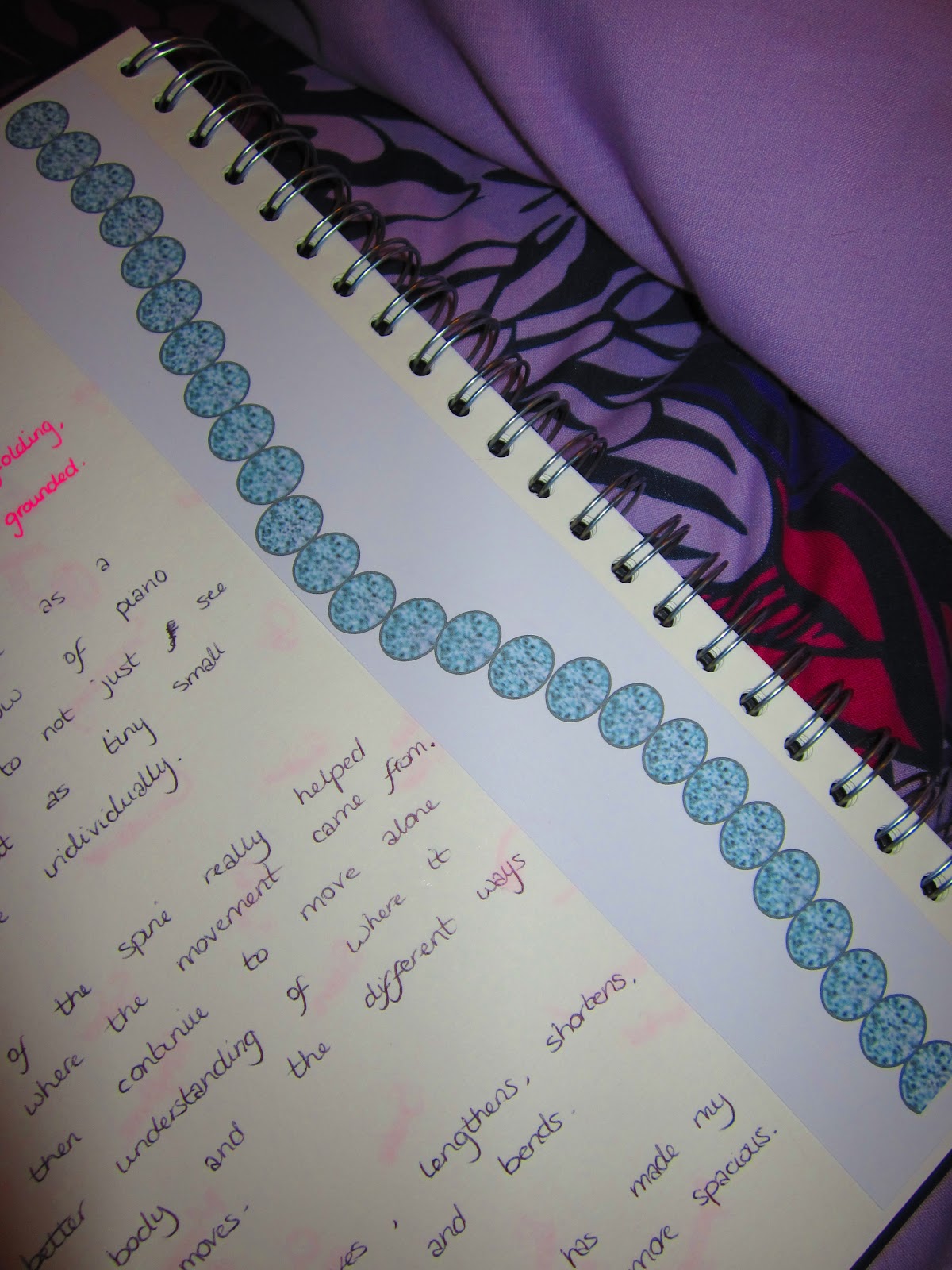
We began the lesson by curling and uncurling the spine.

I imagined.. stretch, waking up, fingers, spine, arch, curve, bend, lengthen, release, tension, toes, flexing, growing, reaching, rolling, relief, folding, unfolding, yawn, awaken, eyes closed, light, grounded...

After discussing the anatomy of the spine and ways in which it moves, I have created my own image. When I think of the spine, I see a line of pebbles or a row of piano keys. This helps me not only to see the spine as a whole but to visualise the individual vertebrae.
 
The picture I created represents pebbles creating the vertebrae of the spine.


Improv 10/10/12

We started by working in pairs with a connection between our spines. We had to feel each others breath through the back. We then had to move but keeping this connection through the spine. I was working with Hannah Gray. After the task we spoke about how I was very engaged in the task and therefore I wanted to explore more. On the other hand, Hannah did not feel as ready as I did and therefore she was more reluctant to try bigger movements.
 
The task progressed and we came into larger groups. It was an odd feeling as we couldn't see who we were working with and therefore we had no judgements of how they were moving and how I should move around them. I feel if I had known before who I was connecting with, I wouldn't have been as open and willing in my movement.
 
After this, we regrouped into our pairs for the next task. This was to find a neglected, empty space within Ellen Terry to sit and observe. We needed to write down what we noticed in the space but individually. After, we could compare our notes.
 
Here is what I noticed:


We found that Hannah wrote more literal notes whereas mine were less obvious. I feel that I did this conciously so that I could find deeper things rather than just scraping the surface.

I really enjoyed this lesson more than expected. I think since last year, my preconceptions of this lesson have changed and now I can fully understand and appreciate them. I can find a deeper meaning to things and use this to benefit my individual dance practise.

Company Name Ideas

 
These are some of the ideas we came up with after reading a piece of writing we were given and after researching into Marina's background.
 
Our final decision was... Small Boat Dance Company

Tuesday, 15 May 2012

Outdoor Score

9th May 2012


  • I tried to use different body parts to support my body rather than just the obvious ones. For examples, |I used my head, elbows, knees.

  • I also concentrated on the shapes my body was making in the space. The angles of my body in relation to the supports I was using.

  • I didn't know how much of the score I would retain and I surprised myself. When I paused I instantly noticed I was aware of my breath in my body.

  • I was very aware of the others in the space with me and the distance between us, whether in close or far proximity.

  • I felt I was very focused during this task and this helped me to notice all the things that I did. I have responded better to this task than others in site responsive dance. I think this may be because I was in a smaller group.


The picture below shows a map of the pathways I took on my journey and the shapes of my body in the space.


Monday, 14 May 2012

14.05.12


In SRT I feel that I respond better by just picking out certain words and creating images in my head in order to help me move. This journal article shows some of the words I chose and the images that correspond with them. It isn't complete but I hope to add to it.

Skinner Class


Monday 30th April

This was our first lesson back after Easter and I was looking forward to getting back into moving again.
We learnt about the Bedroom, Lounge, Garden, Street cycle which is something we have not done before.

This idea originated from Anna Halprin and was intended as a daily movement practise. It is a preparation for site specific work which we are being introduced to this term.

What each area meant to me:
  • Bedroom- Stillness, small, intimate, close, focused in, selfish, intricate.
  • Lounge- Relaxing, reaching edges of personal boundaries, comforting, stretching.
  • Garden- Seeing others, middle ground, crouching, confusing.
  • Street- Open, exposed, big, seeing wider picture, travelling, standing.
I felt very focused for this task and I could very clearly distinguish which areas were my stronger and weaker ones.

My favourite zone was the lounge. I felt most comfortable here and I enjoyed exploring the boundaries and limits of my own personal space.

I felt least comfortable in the garden because I was unsure of what it was and how to move in this zone. Therefore, I spent the least time here.  

Sunday, 11 March 2012

Dance and Disability Discussion

Wednesday 29th February


We spent time during our Improvisation lesson to discuss dance and disability. It is something that I haven't worked with before coming to University and therefore, I am interested to learn more about it.

We spoke about the difference between the disabilities you can see and those that you can't. As a member of Perspective Dance Company, I work with both Karen and Fiona very closely who both have disabilities, so I have began to experience first what it is like. I find it the same as any other class I would take normally. You have to work with things and around things but in the end it is still the same.

I enjoyed hearing Fiona perspective of dealing with Aspergers because I know she can find it difficult to communicate with people at times. Its nice to know more in order to be able to help her if she needs it.

"Different, not necessarily bad."  Fiona Butler

Karen lead a workshop with Hayley on how she has to adapt the practical work in order to accommodate the movement she has in her body. The movements have the same principle but just done in a slightly different way.

Overall, I'm glad I know more about it because it is something I could consider for the future but also helping the people around me now.